
The calm-skin guide
Some skin itches for no reason you can find. It shows up on the hands, the face, the folds of the elbows and knees. It cracks after washing, flares red by evening, and wakes you at 2am scratching. The creams help for an hour. The steroids work, then stop. This guide is about that skin: why it itches, how mānuka honey and beef tallow fix it, and how to use the cream so the calm holds.
Eczema-prone skin does not need more product. It needs a barrier that gets sealed and rebuilt, an itch that gets calmed at the source, and nothing in the jar it has to fight.

Three chapters. Why eczema-prone skin itches, how the cream fixes it, and how to use it and what to expect. Read it top to bottom, or jump to the part you need.
Navigate through the chapters:

CHAPTER 1
Why eczema-prone skin itches
A weak barrier lets moisture out and bacteria in, and the immune system overreacts. Why creams wear off in an hour and steroids stop working.
CHAPTER 2
How the cream fixes it
Mānuka honey stops the itch. Beef tallow repairs the barrier. Olive oil softens, calendula soothes. What is not in the jar.
CHAPTER 3
How to use it and what to expect
Pea-sized, pressed into damp skin, morning and night. What happens in days 1–3, weeks 1–2 and weeks 3–8, and the 90-day guarantee.
Eczema-prone skin has two problems at once: a barrier that leaks, and an immune system that overreacts to what gets through. Moisture out, bacteria in, itch. Fix the barrier and there is less to react to.
The barrier leaks
The outer layer of your skin is a wall. The bricks are flattened dead cells. The mortar is fat the skin makes itself: ceramides, cholesterol and fatty acids. It keeps water in and everything else out.
Eczema-prone skin makes less mortar, so gaps open between the bricks. Water leaves faster than the skin can replace it: that is the tightness an hour after washing. Detergent, fragrance and bacteria get in through the same gaps.
Bacteria get in, the immune system overreacts
Staph lives on everyone's skin without doing harm. On eczema-prone skin it gets through the gaps, and the immune system overreacts. That overreaction is what you feel: the itch, the heat, the redness, the weeping when it is bad.
Then the cycle closes. Scratching opens more gaps, more gets in, the immune system reacts harder. That is why skin goes from fine to a flare in a day.
Night is worst. Skin loses more water overnight, you are warm under the covers, and there is nothing to distract you. The itch that starts at bedtime is still going at 2am, and a scratch in your sleep opens the next day's flare.
Moisture out
Gaps in the barrier let water leave faster than skin can replace it. Tight, dry, cracked an hour after washing.
Bacteria in
Staph gets through the same gaps. More staph on the surface, worse flare.
Immune system overreacts
The reaction to what got in is the itch, the heat, the redness and the weeping.

Why creams wear off in an hour
A drugstore lotion is mostly water. It feels cool going on, the water evaporates within the hour, and the skin is where it started. Petroleum jelly lasts longer because it is a film: it blocks water from leaving while it is on and adds nothing to the wall underneath. When the film goes, the relief goes with it.
Why steroids stop working
A steroid cream shuts the immune reaction down. That is why it works when nothing else does. It does nothing for the barrier, so when the tube stops, the same skin is still leaking, the same bacteria are still getting in, and the reaction comes back. Used long enough, the skin thins and the same strength does less.
The triggers you chase
Every trigger on this list is real. Every one of them gets in through the gaps.
- Laundry detergent and softener. Fragrance and residue in everything that touches your skin.
- Fragrance and essential oils. The most common cause of contact allergy from cosmetics. Essential oils are fragrance.
- Weather. Cold dry air outside, heating inside. Both pull water out faster.
- Hot water and foaming cleansers. They strip the mortar out of the wall.
Cut what you can. But a barrier that leaks finds a new trigger every week. Fix the barrier and most triggers stop being triggers.
Where eczema and psoriasis fit
In atopic dermatitis, the common form of eczema, many people carry variants in the gene for filaggrin, a protein the skin needs to build a normal barrier. Their skin leaks from the start, which is why it flares at triggers other skin ignores. In psoriasis, skin cells turn over too fast and pile into thick plaques, and the barrier inside those plaques is disrupted.
Both are medical conditions with their own treatments. Between flares, both leave skin drier and leakier than normal, and that barrier responds to the same things any damaged barrier does: skin-like fat to seal and rebuild it, and nothing on it that irritates. That is the skin this cream is built for: eczema-prone and psoriasis-prone skin.
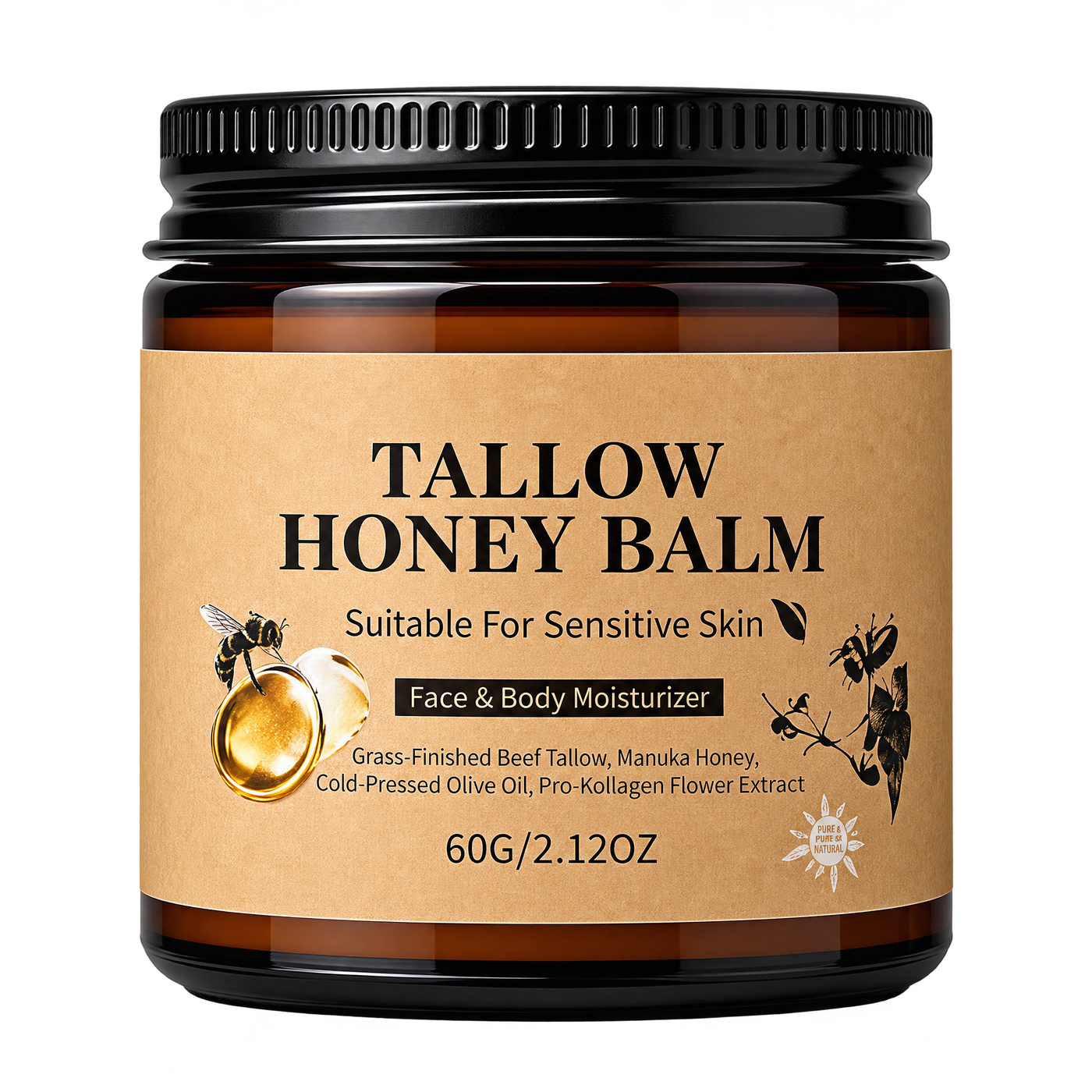
Four ingredients, two jobs. Mānuka honey calms the itch and fights the bacteria that got through. Grass-finished beef tallow seals moisture in and gives the barrier the fat it is made of. Olive oil softens. Calendula soothes. Nothing else.
Mānuka honey stops the itch
Itch is a signal. Nerve endings near the surface fire when the skin is inflamed. Lower the inflammation and the signal drops.
Mānuka honey lowers it from the surface, two ways. It fights the bacteria. All honey is antibacterial: low water, natural acidity, a slow release of hydrogen peroxide. Mānuka has an extra activity from methylglyoxal, a compound from the nectar of the mānuka flower, and it works on staph, the bacterium eczema-prone skin struggles with most. And it calms inflammation where it is applied. In wound research that is less redness and less swelling. On eczema-prone skin it is less itch.
Honey is also a humectant: it draws water into the outer layer and holds it there, so skin is less dry, not just covered. No steroid, no numbing agent, no menthol. The skin is calmer because there is less to react to.
Beef tallow repairs the barrier
Tallow is rendered beef fat. Its fatty acids are the ones your skin's own fat is made of: oleic, palmitic and stearic. It carries cholesterol, one of the three barrier lipids, which no plant oil does, and the fat-soluble vitamins A, D, E and K.
Because it is skin-like fat, tallow does not sit on top the way petroleum jelly does. Press it in and within a minute or two it has moved into the outer layer where your own lipids sit. There it seals: a lipid layer slows water loss for hours, not one. And it supplies: the fatty acids and cholesterol are now where the barrier is rebuilt, so the skin has material to close the gaps with. Day one, the seal does the work. Week three, the barrier underneath does more of it.
Grass-finished matters because fat is where an animal stores what it ate: more omega-3s and fat-soluble vitamins than feedlot fat. Rendered slow at low heat, it is pale, clean and nearly scentless. There is no beef smell in the cream.

Olive oil softens, calendula soothes
Cold-pressed olive oil is the softener: mostly the same oleic acid your skin uses, it spreads the tallow thin and leaves rough patches supple. Calendula, pot marigold flower extract, is the soother: used on irritated skin for centuries, and the plant extract with the most research behind it for calming redness.

Mānuka honey
Stops the itch. Fights staph, calms the inflammation, holds water in the outer layer.

Grass-finished beef tallow
Repairs the barrier. Skin-like fat that soaks in, seals moisture in for hours, and rebuilds the wall.

Cold-pressed olive oil
Softens. Spreads thin and leaves rough patches supple.

Calendula
Soothes. Pot marigold flower extract, for the redness.
What is not in the jar
- No steroids. Nothing that shuts the immune system down, thins the skin, or stops working.
- No fragrance or parfum. The most common cause of contact allergy from cosmetics.
- No essential oils. Essential oils are fragrance. Lavender, tea tree, citrus and peppermint oxidise on the skin into known sensitisers.
- No drying alcohol. Alcohol denat. and SD alcohol pull water and fat out of the outer layer.
- No dyes, no menthol. A colour and a tingle add nothing but a reason to react.
Skin that is already flaring does not need a new thing to react to.
Does tallow clog pores?
Honest answer: whether a fat clogs pores depends on the skin it goes on and how much is used, not on the fat alone. Tallow is rich in oleic acid, and skin that breaks out from rich creams can break out from this one. If your skin is oily and acne-prone, patch-test on the jaw for a week first. Dry, eczema-prone skin is short on fat, not drowning in it. A pea-sized amount pressed in is too little to sit on the surface, and on hands, arms, legs and folds, where most eczema-prone skin lives, pores are not the issue.
Is tallow greasy?
The first second on the skin feels richer than a lotion. Warm a pea-sized amount between two fingertips until it goes translucent, press it in, and it is absorbed within a minute or two. Dry to the touch, not slick. People who find it greasy are using three times too much and rubbing instead of pressing.
Damp skin. A pea-sized amount. Press, don't rub. Morning and night, and again after every wash. Most of what people get wrong is rubbing, using too much, or stopping at week three.
The routine
Start on damp skin
Lukewarm water, pat until slightly damp. The honey holds the water that is there and the tallow seals it in.
A pea-sized amount
Warm it between two fingertips until it turns translucent. That covers both hands, or the face. More does not calm faster; it sits on top.
Press, don't rub
Flat fingertips, press it in. Rubbing is friction, and friction is a trigger.

Morning and night
Night is when the barrier repairs and when the itch is worst. The bedtime application is the one not to skip.
Again after washing or showering
Water takes the seal off. Pat dry and press a little back in while skin is still damp. For hands, keep a jar by the sink.
On every patch
Hands, face, neck, elbows, backs of the knees, shins, folds. Not only the worst one.
Alongside a prescription
Keep using a prescription cream exactly as prescribed, on the patches it was prescribed for. This cream goes on afterwards, once the prescription has absorbed, and on everything else. The prescription handles the reaction; the cream handles the barrier. If a patch is weeping or open, hold the cream back from that spot until the surface has closed.
What to expect
One jar is about a month of twice-daily use. Here is what happens, and when.
Days 1–3
The tallow seals the surface and moisture stops leaving. The mānuka calms what is already inflamed. The itch, the sting and the tightness after washing settle.
Weeks 1–2
Dry, red patches look calmer, wherever yours sit. You stop catching yourself scratching, and you stop waking up scratching.
Weeks 3–8
Skin holds calm through the day instead of flaring by evening. The barrier is rebuilt with the fat the tallow put there. Keep going. Eczema-prone skin goes back to reacting when the routine stops.

Why two jars
The first month gets skin to the point where calm holds through the day. That is one jar. The stretch after, where calm becomes the default and you stop thinking about your skin, is the second and third. Three jars is about three months, from itching to not noticing.
One jar is $39.99, or $29.99 on autoship. Buy 2, Get 1 Free is $79.98 for three jars, so the whole protocol is covered.

The 90-day money-back guarantee. Use it for 90 days. If the itch is not better, email support@trywondernaturals.com and we refund the order. Ninety days is longer than the timeline on purpose: it covers the two-jar arc, so trying it costs you nothing.
What if it stings when I put it on?
Nothing in the jar should sting: no fragrance, no essential oils, no drying alcohol. On cracked or raw skin, honey can feel sharp for a few seconds because it is acidic and touching exposed nerve endings. That fades as the surface closes. If a sting lasts longer than a minute, or skin goes redder, stop and patch-test on the inner arm for two days.
Do I still need a separate moisturiser?
No. The tallow is the moisturiser, and the honey, olive oil and calendula are in the same layer. Nothing goes over it at night. In the morning, sunscreen on anything exposed, fragrance-free.
Final thoughts
Eczema-prone skin is not asking for more product. It is asking for a barrier that gets sealed and rebuilt, an itch that gets calmed at the source, and nothing in the jar it has to fight. Beef tallow does the first. Mānuka honey does the second. Leaving out steroids, fragrance, essential oils, alcohol and dyes does the third. Pea-sized, pressed in, morning and night, every day.
Manuka Honey & Tallow Cream — 90-day money-back guarantee.
Sources
- Mavric E, Wittmann S, Barth G, Henle T. Identification and quantification of methylglyoxal as the dominant antibacterial constituent of Manuka (Leptospermum scoparium) honeys from New Zealand. Molecular Nutrition & Food Research, 2008.
- Burlando B, Cornara L. Honey in dermatology and skin care: a review. Journal of Cosmetic Dermatology, 2013.
- Kong HH, et al. Temporal shifts in the skin microbiome associated with disease flares and treatment in children with atopic dermatitis. Genome Research, 2012.
- Rawlings AV, Harding CR. Moisturization and skin barrier function. Dermatologic Therapy, 2004.
- Feingold KR, Elias PM. Role of lipids in the formation and maintenance of the cutaneous permeability barrier. Biochimica et Biophysica Acta, 2014.
- Russell MF, Sandhu M, Vail M, Haran C, Batool U, Leo J. Tallow, rendered animal fat, and its biocompatibility with skin: a scoping review. Cureus, 2024.
- Daley CA, Abbott A, Doyle PS, Nader GA, Larson S. A review of fatty acid profiles and antioxidant content in grass-fed and grain-fed beef. Nutrition Journal, 2010.
- Givol O, Kornhaber R, Visentin D, Cleary M, Haik J, Harats M. A systematic review of Calendula officinalis extract for wound healing. Wound Repair and Regeneration, 2019.
- Johansen JD. Fragrance contact allergy: a clinical review. American Journal of Clinical Dermatology, 2003.
- Palmer CN, et al. Common loss-of-function variants of the epidermal barrier protein filaggrin are a major predisposing factor for atopic dermatitis. Nature Genetics, 2006.
Filed in: Skin science